Geography
Norsriia is the name given to the mountainous area north of the Sea of Swords. It is a rugged coastline of mountains cut through with deep fjords around which the largest Norsrii steads (settlements) are built. Beyond the fjords and coast are the mountains; high peaks that shield the south from the arctic storms that sweep down from the Great Glacier to the north. This is a huge area of ice and snow-covered tundra that blankets the far north as far as people have ever explored. It is inhabited by a race of people known as Ice Warriors; nomads who hunt the elk and mammoth herds that live on the tundra. They often raid south into Norsrii lands for goods and slaves.
One aspect of the mountainous and unstable geography is the abundance of mineral wealth that is mined by the Norsrii. This wealth of natural treasures, such as Iron, tin, copper and amber are traded by the Norsrii between communities and with the Dominion to the south. Norsriia is also famous for its large and dangerous animals that provide some of the most prized firs in the world. The most common are the elk, mammoth and goats that roam the mountains and valleys. Hunting them are the giant cave bear, the mountain cat and most famous are the great wolves. The Norsrii hunt these animals and trade these furs for those resources unavailable in their native land.
Most settlements in Norsriia are small fortified villages that cluster around the numerous hot springs and rivers that dot the region. These small communities are typically set in the many valleys that cut through the landscape. Norsrii steads have a typical population of twenty to thirty family groups and are built around a large central Mead Hall where the stead chief lives and the community gather during the cold winters’ evenings. Of equal importance to stead life is the smithy which is build either next to or opposite the Mead Hall. Larger steads can contain a bathhouse if there is a hot spring nearby and a trade house. Most Norsrii houses are very old having been built up over generations by successive members of the same family. Each house typically has mortared stone walls with a wooden roof and support beams that are carved into intricate designs, the houses are then roofed in whatever local materials are available, be it pine shingles, slate or thatch, although the latter is rare given the lack of arable land turned over to wheat production. The roof is typically slopped at a steep angle to encourage snow to slide off and wide eves to provide a gap between the stone wall and any build up of snow in winter. This design makes Norsrii houses very strongly built and warm during winter. Most steads are also defended by a mortared stone wall with fighting platforms and towers built along its length, which are garrisoned by everyone in the stead.
In the minds of everyone to the south, Norsriia is a land of ice and fire, snow and volcanoes, a land of warriors and traders who are as likely to sell to you as they are to kill you and take what you have. To the Norsrii it is the land that has forged them into a race to be feared and respected throughout the world.
History
Norsrii legends tell that in their earliest days they lived with the Gods in paradise in a distant land to the West. There they were servants and warriors who fought the God’s wars and tended their hearths. During one of their many wars amongst themselves one God began to throw his warriors and servants into seemingly pointless battles that cost thousands of lives.
Disgusted by this treatment, the ancestors rebelled and led a long and bloody war against their masters. After many eons of struggle the final battle was at hand with the ancestors close to victory. However, at the moment of their victory, when the mightiest warriors had stormed the fortress of the Gods, cast them down and were feasting on their hearts, the Gods launched their revenge. The land shook, rocked and tore and a great cataclysm fell upon the land.
Twelve of the strongest heroes gathered what knowledge and artefacts they could and lead a group of refugees to the east and fled in the ships of the Gods. They sailed for many days and nights before reaching a land of mountains and rivers where they decided to settle. The place they landed is now known as Landfall and is the sight of the oldest and largest Norsrii settlement. The twelve warriors agreed to split up and settle the land and be beholden only to themselves. They made three pledges; they would meet once a year at Landfall to trade and share tales, they would never again blindly follow any god and they would always honour the warrior as it was they who had freed them from the tyranny of the Gods.
As time passed, the twelve warriors and their followers expanded and grew into the twelve largest clans, taking local animals as their totems; The Wolfs Head, The Bear Clan, The Snow Leopard, The Sea Hawks, The Elk Clan, The White Eagle, The White Wolves, The Sea Dragons, The Great Mammoth Clan, The Ice Wyrm Clan, The Ice Fiend Clan and the Kraken Clan.
Over the years, the Clans adopted the attributes of their totem animals and a Norsrii can tell a warrior’s tribe just by looking at them. A Wolfs Head Clansman is often tall and well-muscled but with a lean and dangerous feral look to them, while the Ice Fiends are huge, muscled warriors, swathed in the pelts of their name sakes. Each Clan expanded, settling the land, mining, lumbering and discovered huge natural resources. It was in these early days, that the abundance of iron was realised and the role of the smith began to take a more central role in stead life. Very soon, the production of high-quality steel, metal goods and weapons became a cornerstone of Norsrii trade.
The first Norsrii contact with other races was the Ice Warriors on the Great Glacier to the north and this hostile contact helped to encourage their warrior nature. However, trading was still important and this flourished when the first sailors reached the southern shore of the Sea of Swords. This was the start of a healthy trading relationship with the Varren, the indigenous people of that land.
This relationship lasted for generations, until the rise of the Archon Empire. As the dominant power in the south grew and expanded, coming into conflict with, and conquering more people, the demand for Norsrii steel and warriors grew. As the centuries of conflict passed the Norsrii became renowned warriors whose services were in high demand.
The final battle of the Archon war with the Varren was the Battle of the Three Kings where the King of the Varren and the Battle King of the Norsrii fought the Emperor of the Archons to a bloody standstill. On the field of battle, the Varren capitulated and chose to become part of the Empire, while the Norsrii refused to bow the knee and withdrew to their ships, sailing north.
This withdrawal marked the start of centuries of hostility between the Norsrii and the Empire, marked by coastal raids by both sides, attempted invasions by the Empire and then bloody reprisals by the Clans. This pattern of violence continued until the Empire began to collapse from internal pressures and the advance of the Suevian tribes. The Norsrii took full advantage of the chaos, attacking and sacking towns and cities and hiring themselves out to the highest bidder. It was during this time that the reputation of the Norsrii as fearsome warriors and deadly raiders was cemented in the minds of the people of the Empire.
As the Suevians conquered the remaining Empire provinces and created the Dominion of Suevia, the Norsrii returned to their lands and settled into a routine of trading and mercenary work with the new continental power that lasts to the present day.
People
The people of the north do not call themselves Norsrii, it is a name given to them by the people of the south, however it serves them well as an easily identifiable tag. They call themselves The Tashrial, it translates as Survivors in the tongue of the ancestors.
Norsrii are typically tall, well-muscled with light brown to blond colouring, they are renowned for their great strength and endurance, able to run great distances and fight a battle at the end of it. The Norsrii also heal faster than other peoples and can recover from wounds that would kill a normal man. A side effect of this is that a Norsrii will often live far longer than the average life span, the oldest typically reaching their 80s or 90s. However, few rarely make it this far as they are often killed in battle or raids.
Norsrii believe that their strengths are derived from the Gods. Legends tell that the first ancestors battled the Gods and after many years of warfare they cast them down and ate their hearts, this conferred on them the gifts of great strength, endurance and healing. As well as other traits, specific to each clan.
All Norsrii use tattoos to mark their clan affiliations and tell the stories of their lives and achievements. Since they have no formal histories and their lives are often spent wandering and fighting, a warrior’s body announces to other Norsrii, their rank and achievements and act as a story of their life when they die. The “Tapestry”, as it is known begins with a standard knotwork band around the left wrist and slowly progresses up their arm, shoulder and chest. The left arm is significant as this is the typical shield arm and therefore protected, thus preserving their story.
Culture
The Norsrii have a strong warrior culture with every man or women, learning to fight and survive for the betterment of society. Children are trained by their family and by experts in the village in skills which include; hunting, survival, fitness, unarmed combat, swordsmanship, archery and fighting as a war band. Metal working skills are very important to the Norsrii, with all youths from the age of six, spend time in the forge learning to work steel.
Men are the predominant fighters with the women left to look after the home and raise and train the children when their husbands are away. However, single women or those with adult children will often fight with the stead war bands. Since the Norsrii exist in a harsh land, fighting is a way of life and their culture has evolved to honour the warrior above all others. An individual’s standing in the village and clan is based on their ability to fight. It is considered essential for their race survival as it weeds out the weak and promotes the strong. Norsrii youths will often sign on with a mercenary band in order to prove themselves in war and gain wealth and renown.
The secret of forging is tied into the mythology of the Norsrii and forms a huge part of their lives. Each youth undergoes their adulthood rite at the age of 16. They must forge their own sword, a Spata, before being sent out into the wilderness for 3 days. They are blindfolded and led away from the village before being released to find their way home, they only carry their Spata, loin cloth and clan cloak. Once they return, they are considered an adult and join the clan.
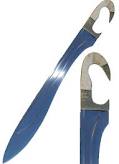
A Spata is a single bladed short sword designed for thrusting and chopping, originally a farm tool it is the signature weapon that all Norsrii carry. The Spata has a single edged blade that pitches forward towards the point; the edge is concave on the lower part of the sword, but convex on top. This shape distributes the weight in such a way that the Spata can deliver a blow with the momentum of an axe, while maintaining the cutting edge of a sword. The hilt is typically hook-shaped and the end is often stylised in the shape of a totem animal of the wielder. The sword is folded 20 times to make it strong, flexible and incredibly sharp. In battle the Spata is excellent in the close quarters of a shield wall or ship boarding and can be used either in a chopping motion or for thrusting.
All Norsrii warriors carry secondary weapons such as spears, long swords and axes. Their armour consists of whatever can be bought, made or salvaged but typically consists of leather armour with steel plates or chain mail. A warrior’s rank and standing can be inferred from the quality of their arms and armour. All warriors can use the hunting bow, which they learn from an early age.
They are keen traders as they have little land to grow crops so must trade to survive. Each spring the clans send ships into the Sea of Swords and The Tethys Sea to trade amber, pelts, steel and weapons. On occasion, they will raid a tempting target if the reward outweighs the reward. This unpredictability makes them feared throughout the Dominion and the Karanid Empire, but they are tolerated because of the quality of their trade goods.
The Norsrii have no central government but a number of independent clans controlled by Jarls that come together in times of war. When the need arises, a council of Jarls elect a warlord who commands the clans and offers a form of centralised government.
Norsrii live in clans with each occupying a large area of land. Each clan area has numerous family groups living in well defended villages called a stead led by a village headman and a single strong central castle, called a Hold, where the Jarl lives with his Karls, his retinue of professional warriors.
The Norsrii are in a constant state of tension with the Dominion of Suevia. This is caused by occasional sea raids by desperate steads. Because of the lack of central control, there is no way of stopping steads that have a poor season from raiding to survive. This leads to a mixed impression of the Norsrii and random acts that can some time lead to war.
Their warrior culture will often lead to large numbers of youths signing on as mercenaries in the Dominion or the Karanid Empire.
Religion
For reasons of history the modern Norsrii worship no gods but revere their ancestors and honour their achievements with gifts and prayers.
They do believe in an afterlife but not one ruled over by a god. Instead a warrior’s soul is sent to the Hall of Heroes where their actions are judged by those who have gone before. If they are deemed worthy, they are welcomed to an eternity of drinking, fighting and merriment with friends and family. If they are deemed not yet worthy, then their soul is returned to life to try gain enough renown to be worthy. If a soul is found unworthy, it is cast into the frozen oblivion of Hel and destroyed forever.
Military
The Norsrii favour infantry tactics and have a strong naval tradition. Their typical fighting style calls for the warriors to form a shield wall and advance on the enemy. Once at close range heavy harpoons are thrown at the enemy shields to drag them down allowing them to close and kill the enemy. Heavy spears are often used when charged by cavalry.
When fighting as mercenaries, they are often employed as shield breakers. Elite troops who use their savagery and power to break open a shield wall, then cut it apart from the inside. The size and strength of the Norsrii compared to the men of the southern realms makes them perfect in this role.
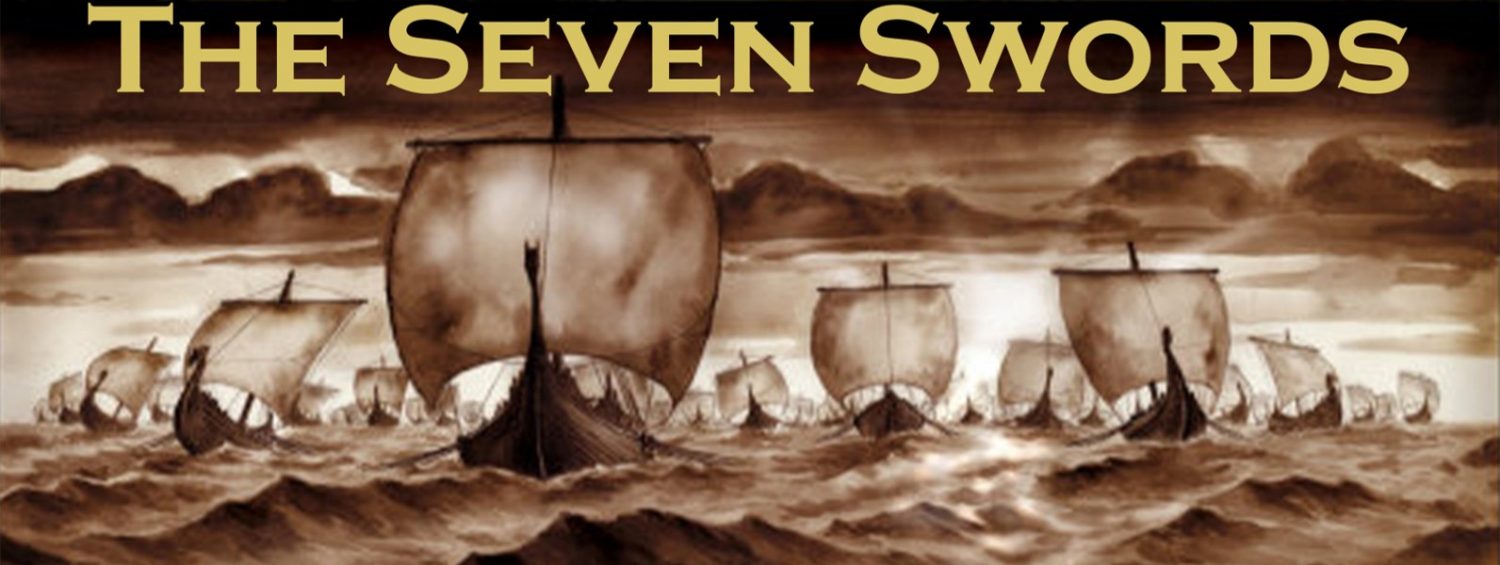
Norsrii typically build Long ships, called Dragon Ships, of various sizes; small and fast for raiding and larger, slower vessels for trade. The Norsrii try to avoid naval battles due to the lack of mounted weapons in their ships. They will attack merchant vessels if they can but will avoid warships at all costs.
Over the centuries of on off conflict with the south, the twelve most powerful Clans have captured a number of Archon war galleys. While, these ships are predominantly used a status symbol, as the most powerful ships in the world, they are only used in the biggest raids or wars.
Notable Cities
Landfall is the oldest and greatest city in Norsriia. Legends tell that is was the place where the first Norsrii landed after fleeing their homeland and settled for a year. Landfall today is a large city by Norsrii standards but small by the measurements of the Dominion and the Karanid Empire. It has a population of around 20,000 people and is ruled over by a council of Thanes drawn from the town population. Unlike most towns, Landfall is not ruled by a Jarl, as by common consent the Clans view the city as neutral territory open to all. It is the largest trade port in Norsriia and hosts the annual meeting of the Clans.
The city itself is built on top of a huge granite promontory called Home Rock that juts into the sea and curves protectively around a wide shingle beach that cuts into the walls of the surrounding fjord. The houses of the poor are built on the lowest part of Home Rock closest to the beach and just above the docks that are built there. In addition to the docks, are the warehouse district and all those industries not permitted inside the city walls such as tanners, dyers and slaughter houses. As one progresses up the slopes of Home Rock the houses get more and more expensive until one reaches the houses of the Thanes that surround the city’s castle, The Rock.
The Rock is built on the furthest part of the promontory and protects the entrance to the bay as well as acting as a last refuge should the walls be breached. It is a huge edifice of granite, built up over the centuries into a vast central citadel and a thick curtain wall that bristles with bolt throwers and catapults capable of raining death on anyone foolish enough to try to force a landing in the bay. Many times in its history the Rock has had to fend off attacks from the Archons and Suevians but no enemy has every breached its defences. The city is defended by the Stone Karls, the body of professional warriors who are sworn to defend the council of Thanes. They patrol the walls as well as the streets to keep order. In times of danger they are aided by the population of the city, who, being Norsrii, are all capable warriors. It means that any attacker would face an army of 20,000 warriors ready to defend their homes, as many an invader has learnt to their cost.
Beyond Home Rock, the fjord continues into the mountains and dotted along the shoreline are the farms and mines that supply the city.
Factions
The Blood Reapers are a splinter clan living in the far north of the Norsriian coastline. They have fallen to worshipping the old god of murder, Heshla and raid Norsrii and Suevian settlements for sacrifices. They are universally hated and feared and are killed by the Norsrii on sight.
 Tom Holroyd