Geography
The Dominion of Suevia occupies the central plains and lowlands of the main continent of Terra Nostra. Bordered by the Arian Mountains to the north, the Sea of Swords to the north east, The East Way river, the Amar Gulf and the Horde Lands to the east, the Karanid Empire to the south across The Tethys Sea and the Great Ocean to the west.
The geography of Suevia is dominated by mountain ranges on its borders and a large central range, The Dragon Heart; all of which supply wide flowing rivers to the lowland plains that facilitate trade and travel. Most major cities are founded at the confluences of major rivers, making them the centres of communication and trade within the Dominion. The lowlands consist of fertile farmland, large dense forests and wide rivers. Its position and natural resources make it a focal point for trade and therefore very wealthy as well as a melting pot of people and cultures.
History
The Suevian tribes originally came from the steppe land far to the east and invaded the Archon Empire after being driven from their homeland by an unknown foe. The Archon Empire was the main power at the time but had entered a period of decline, riven by civil war and internal dissent. The Suevian tribes crossed the East Way in their thousands and descended on the Empire crushing every army sent against them. Over the course of a century the Empire lost more and more cities and territory, soon their capital fell and the Emperor was forced to relocate to the west coast of the Empire. Even though the Suevian tribes became the dominant power soon after capturing Archonopolis they continued their conquest, eventually culminating in the Battle of Fate where the Archon Emperor and his family were killed and the last embers of the resistance was crushed.
With all military resistance ended, the new rulers set about organising their new dominion. The land captured from the now dead or displaced Archon nobility was divided up amongst the leadership of the Suevian tribes. They then divided the land further between their warriors and retainers in exchange for fealty and military service. This first act would lay the foundations of the noble houses that would become the foundation of the Dominion. To keep the new nation running, the leading nobles kept the existing Imperial bureaucracy in place and offered a general amnesty to all who had fought against them.
Within a generation, the Suevian invaders had become integrated into the fabric of the old Archon Empire and while the name and the ruling class had changed, for the common man, life went on very much as before.
However, all was not to remain peaceful. With the death of the Emperor, the Suevians had elected a body of the most powerful nobles to run their lands. This body was known as the Lords Council and ruled well and wisely for many years. That was until the rise of Palagius the Mad. The second son of a council member, who, over the course of five years, managed through a combination of guile, bribery and outright murder, to remove both his elder brother and father and take their place on the council. Over the next few years, he gained power and prestige before making his final move. At the age of twenty-nine, Palagius orchestrated an internal threat from a splinter cult of the Source and named several leading nobles as heretics. With the backing of the Church and their Templars he arrested them, declared their lands forfeit and exiled their families. To maintain stability, he declared himself High Lord and set about consolidation his power. The move was so sudden that the other nobles did nothing for many years allowing Palagius to become unassailable. Two years later he declared himself King and renamed Suevia as The Dominion of Suevia, ruling as an all-powerful King for over forty years.
In the early years, he ruled well and wisely but as the years passed, he became paranoid and began to see threats in every corner. He ordered arrests, torture and state sponsored murder on an epic scale. Finally, unable to stand the tyranny any longer several houses rebelled and the Dominion fell into civil war. For three years, The Kin Slaying Wars raged across the Dominion with the rebels slowly gaining the upper hand. Eventually the capital was stormed and Palagius killed on his throne. With the end of the war the victorious nobles ruled that no man would ever become king again and created an elected post of High Lord to lead Suevia.
The next century was a time of consolidation and establishment of the current social order. However, this peace was threatened by the arrival on the southern coast of The Tethys Sea of a new power. The Karanid Empire swept all before them as they conquered the tribes of the coast and the former lands of the Archon Empire. They were eventually stopped at Marcher, the ancient and huge fortress that controlled the eastern coast of the Tethys Sea. For the next 140 years, the two powers fought back and forwards over Marcher and the disputed lands in what would become known as The Border Wars. It was a time of fear as raiding fleets pillaged the coastline, battles raged and cities burned. It culminated in the Treaty of Skandaria which ended the war and stabilised the frontiers at their current borders, although neither side was particularly happy with the terms.
Suevia today is a nation at peace but there are constant threats from the Arians, the Norsrii, the tribes across the East Way and the ever-present threat of the Empire across the sea, are always in the back of every warrior’s mind.
People
There are many different people within the Dominion of Suevia. When the Archon Empire expanded, it conquered and absorbed the different groups in the surrounding lands and incorporating them into the social structure of the Empire. The real strength of the Empire was its ability to take conquered and resentful people, make them feel part of society and thereby valued. They did this by giving them a say in the running of the Empire, building roads, baths and allowing them freedom of religion but changing their daily lives very little.
When the Empire fell and the Suevian High Lords inherited the lands and people, they changed very little and thus there remain several distinct groups within the Dominion, each with their own racial characteristics and cultures and traditions.
The north of Suevia is occupied by the Lothgor, a race of dark-haired men who are rumoured to have migrated from The Horde Lands in times past. They live in the lands north of Archonopolis and between the coasts and The East Way all the way to the Arian Mountains. They are a hardy race occupying a harsh land of pine forests and high hills with the constant threat of raids from the Norsrii, the Arians and the Horde Lands. They are thought of by everyone else as a cold, hard people from a cold, hard land. Winters here are long and summers short with a wet spring and autumn.
To the North west are the lands of the Varren, a race of tall and well-built people. Often blond in colouring they are thought to be cousin to the Norsrii but have no relation to them. They are good fighters and traders. Their lands are temperate and well-watered from the rains off the Sea of Swords. They have a mixed history with the Norsrii, in the early days they were allies and friends but when they became subjects of the Archon Empire and later the Suevians they were often raided or invaded. The Noble Houses here produce some of the finest warriors of the Dominion.
To the south east lie the lands of the Valtiri, a people of horses who favour cavalry over infantry. They are perfectly suited to their land which is dominated by the Valtir Plain and The Deep Wood. They are typically a tall and rangy people with blond hair and blue eyes who are excellent horsemen. Most Noble Houses in this area have excellent cavalry and horse archers and are renowned for breeding horses and cattle on the wide plains. The land is green and verdant, flourishing on rains from the east and west but enjoying the warmth of the sun.
To the south of The Dragon Heart are the ancestral lands of the Pavoni. They are a dark haired and olive-skinned people, tanned by their warm climate. They speak with a musical accent and are renowned as artists, scholars and producers of some of the finest wines in the world. Pavonia is a very fertile region and almost any crop can grow in its lands. This makes it known as the bread basket of the Dominion.
In the Dragon eye peninsula live the Oreoni, cousins of the Pavoni they are also of an olive complexion but are different in personality. They are a gruff and insular people, likely from their hot and dry terrain around the Dragon Eye Mountains. They are constantly being raided by the Norsrii, Karanids or pirates, which make them hardy fighters and intensely warry of strangers.
In the Tethys Sea, off the coast of Marcher, lies the island nation of Cyrius home to the Cyrians a fierce warrior people who while nominally part of Suevia are in reality an independent power. They are sailors and shipbuilders beyond compare and their services are in high demand. In times past both the Suevians and the Karanids have bought their ships and sailors to fight in their wars. The island is ruled by the Mariner King, a hereditary ruler who exercises absolute authority over the island. The people are short and stocky often walking with a rolling gait that one would expect from a people who spend most of their lives at sea. They are traders, slavers and occasional pirates and are a touchy and unpredictable power.
Culture
The Dominion is a mix of cultures built up over centuries of conquest, Imperial rule and amalgamation. In Suevia all land is owned by noble families; each family’s power depends on its holdings and the wealth and power that can be generated from the land. The largest and most powerful houses own huge swathes of land across the Dominion as well as holding the allegiance and vassalage of many minor houses. Each Noble family possesses their own House Troops drawn from and supported by their holdings.
The head of the Dominion is the High Lord; this is not a hereditary position but goes to whichever family holds the most power. Whoever can seize and hold the Dragon Throne in Archonopolis, either through force or guile is named High Lord by consent of the Council of Nobles
All noble houses compete for power and prestige with each other but try and stay away from open conflict, although this often happens. They are often bound by complex bonds of family, political ties, vassalage and trade which can make all dealings between them incredibly complex. However, one rule is sacrosanct, when one house with the same blood calls for aid, then all others are honour bound to answer, regardless of whatever other political ties they have. Because of the resulting chaos the Blood Call can cause, they are generally avoided except for the direst circumstances.
Suevian social structure is very rigid; The noble families are at the top in their own complex and shifting ranking, then come the warriors of the House and Dragon Guard. Next are the main body of Suevian citizens, known as Freeborn, made up of merchants, guild members, civil servants, tradesmen and free farmers. Lowest in social rank are Freedmen, who are all freed slaves and often find roles as servants, tenant farmers and workers. Lowest on the social ladder are slaves.
Slaves have no rights and can be treated by their owners however they wish. Slaves are either born into that class or are captured enemies or criminals. Captured warriors are often employed as gladiators in the very popular Games. Slaves are marked out by the Iron Collar, a strip of iron that circles the throat and is welded in place leaving a permanent burn scar at the back of the neck. This makes the collar very hard to remove except with the aid of a blacksmith and it is illegal to do so without a High Lord’s Writ. Even once a slave is freed the burn remains, forever marking them out as a Freedman.
Following the conquest of the Archon Empire the Suevians formed the warrior, landowning and ruling class, replacing the old Archon noble families but leaving the varied people of the Empire alone as subjects of the new Dominion of Suevia. This does create some social tension as there are enough “Old Families” left to desire a return to the old ways as well as cultural snobbery. All things Archon are considered to be of a higher standard and class. In addition, many activities that were the cornerstone of Archon culture such as gladiatorial games and baths were so popular that they were kept by the new rulers despite the objections of their Source Church who thought the activities were immoral.
Honour is an essential part of Suevian culture, each person must act with honour and behave properly according to their social class and pay homage to those who are of a higher rank. For nobles and warriors their honour dictates the rules that they live by but it is often used as a shield for their actions and an excuse for some of the worst behaviour.
Suevia is in a constant state of cross border raiding with the Norsrii clans and is often raided by the Arians in the North. There are occasional raids into the Horde Lands to keep the tribes pacified and separated. The Dominion is in a state of cold war with the Karanid Empire with occasional naval and land skirmishes. Suevia shares a land border with the Karanid Empire, known as The Marches. The ownership of this area is disputed and there are frequent border clashes.
Religion
Suevians have a strong state religion. The follow a monotheistic cult called the Source of All Life, or more commonly The Source. They believe that all earthly life is derived from their god and that they are his servants and should act in his service at all times. The Church uses the symbol of a river to illustrate how all life comes from The Source and will eventually return to him.
The Church is run by priests who are all female, male priests do exist but they are limited to the role of servants and wandering friars. The Church is technically not a holder of secular power but they exert a huge influence on the nobility as well as holding a large amount of land which has been gifted to them by nobles hoping to expunge their sins. They also command a large standing army of holy warriors known as Templars who protect the Church and its holdings. They are not a tolerant faith and persecute those they consider to be heretics or deviants with a holy fervour. Throughout history there have been several Holy Purges, that round up and burn the unbelievers in huge numbers.
The Church is dominant throughout the Dominion with a chapel or shrine in even the smallest villages tended by a Mother. However, there are still a number of old religions left over from the Archon Empire with significant numbers of worshippers that operate as underground sects.
Military
There are two types of soldiers in the Suevian Military; House Troops and The Dragon Guard.
House Troops are drawn from the population of the lands under control a House. To be accepted as a member, one must either be the son of an existing house soldier or be related to one. While this system does tie the soldier to the House through blood and family loyalty, it does mean that their numbers are kept low as one cannot recruit widely or replace numbers quickly. House Troops are armed and equipped to various standards based on the wealth of their house. However, because wealth and power can be seen in their men, lords will often spend lavishly on their soldiers. Smaller houses will often equip their men with chain mail and a cloth surcoat as they are easier and cheaper to produce, while large and more powerful houses will have unique and distinctively designed armour to easily identify their soldiers. Plate armour and extravagant decoration are typical of the more powerful and flamboyant houses.
The Dragon Guard are similar to House Troops in that they recruit only from the families of existing soldiers, however they have the advantage of geographic spread when recruiting. The Dragon Guard are drawn from families in all corners of the Dominion and as such are much larger than any one Noble House. The disadvantage they have is that the Guard is spread across the Dominion garrisoning cities and castles; meaning that in times of war the High Lord must rely on his nobles to fight an external enemy.
The Dragon Guard are equipped from the finest smithies in the Dominion and are the only soldiers who are permitted to wear the Purple of the Dragon, the colour of the High Lord. All the Guard are equipped to a standard design; a silk tunic and woollen hose whose sleeves and legs from the knees and elbows down are of chain mail, over this is worn another short sleeveless leather tunic which acts as padding. Next comes a steel cuirass embossed with the dragon sigil, this cuirass had a raised collar that protects the throat from slashes and angles out at the hip and chest to help deflect blows away from the body. Five lamed shoulder pauldrons are attached to the shoulder to protect the upper arm and six lamed tassets protect the upper leg. Lastly comes the steel greaves and vambraces which sit over black leather boots and gloves. The Guard helmet is a plain steel skull to which is welded a curving neck plate and cheek guards stylised to resemble dragon wings with a dragon head that forms the nasal bar, underneath the helmet all Guardsmen wear a black silk scarf that covers the lower half of their face, this is to intimidate their enemies and make them all look alike. The final part is the purple woollen cloak that symbolises the Guard’s role as protectors of the High Lord and the Dominion.
All Dragon Guardsmen are equipped with a long sword that can be used on foot and on horseback, an eight-foot spear that doubles as a lance and a rectangular shield that has curved edges at the top and bottom to prevent rubbing when on horseback. Each Guardsman is also a capable archer but rarely fights as such given his armour and typical role of mounted infantry.
Both Dragon and House soldiers are organised along the same lines. A group of up to ten soldiers are known as a Patrol and are led by a Patrol Leader. Ten patrols make up a Company led by a Company Commander. Ten Companies make up a Legion and is led by a War Commander. However, these numbers often vary due to attrition, casualties and sickness. Most Houses can boast an average of two to three Companies, 200-300 men while only the largest can field a Legion. The Dragon Guard by contrast is made up of fifteen Legions. All soldiers are a mixture of spear men, archers, swordsmen and cavalry and in the case of noble houses the Lord will often lead a bodyguard of heavy cavalry. All Suevian soldiers, both Dragon and House are well trained and disciplined troops. They dedicate their entire lives to their calling; training every day, exercising and drilling.
When the Dominion goes to war, it is as much a political exercise as a military one. Because of the duties of the Dragon Guard, an army must be made up from a confederation of houses. Each house will pledge a levy of troops to fight under the leadership of an elected general. Each contingent that is pledged depends on the size and power of the house and it is often the lord who pledges the largest contingent who will lead the army.
Mercenary bands are often used to bolster numbers or to provide a special capability. They are often used in inter-house wars as they are a deniable and inexpensive asset. Some mercenaries become so well known that they become mercenary generals, a useful choice to command an army should a Suevian noble be hard to come by or politically difficult to appoint. Culturally, mercenaries are looked down upon by most Suevians but they are tolerated as a necessity.
The Dominion has a large galley-based Navy that mount powerful catapults and ballista as well as a ram. The standard warship of the Dominion is the Raptor, it is 100m long by 25m wide and has three sails, two decks and a bronze ram that runs beneath the water line. The ship can be manoeuvred by sail or oars, of which it has 40 down each side. It is a fast and heavily armed ship with a crew of 100 sailors, who man the sails when a full wind is blowing or the oars in battle and moments of calm. They help to defend the ship when in battle. Also aboard are 25 Marines, a special detachment of the Dragon Guard, who operate the numerous bolt throwers and lead any boarding action. In battle, tactics consist of firing volleys of missiles at an enemy to kill as many men as possible on board before closing with the enemy ship. They then either ram or board the enemy to capture the ship.
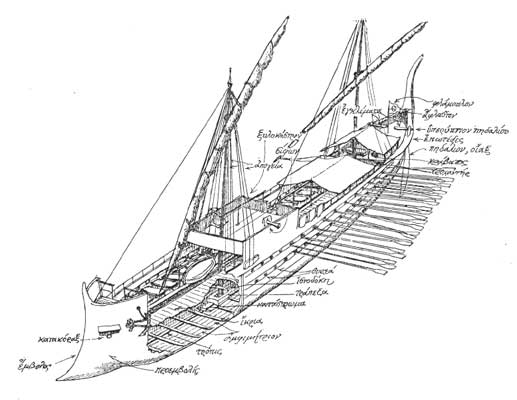
The Navy is under the control of the High Lord and the central government. There are two reasons for this; one the huge cost of building and maintaining a Navy could only be met by the Dominion as a collective and secondly for security. No High Lord wants a house running around with its own fleet causing havoc on the high seas. For this reason, the ownership of warships by anyone but the High Lord is forbidden and every captain is a decorated veteran of the Marines appointed by the High Lord. The crew are either volunteers or pressed men from the ports of the Dominion, slaves are not used as crew as they are considered a waste of resources, will not fight for the ship and are just extra mouths to feed. Dominion sailors are well paid and can become rich off the spoils of war, making it an attractive option for Freedmen and Freeborn alike.
Notable Cities
Archonopolis was the jewel in the crown of the Archon Empire. It was the birthplace of their Empire and the seat of power until it was captured and sacked by the invading Suevians. They subsequently took it as their capital and have ruled the Dominion from there ever since. Today, it is still the largest city in the Dominion and home to some of the most spectacular architectural wonders of the Empire and the Dominion. The city is built at the confluence of the Blue and White Patris rivers and is spread across three large hills; the God Mount, once the site of all the temples to the Old Gods but now the site of the High Cathedral of the Source. The Imperial Mount, site of the Imperial Palace and the Citadel, once home to the Emperor but know the seat of the High Lord and his court. The Trade Mount, site of the main city market, forum and trade guild headquarters. It has a population of close to 1 million people.
Nordgate is a fortress city that is the largest, most northern city of the Dominion. It is heavily defended and garrisoned by the Wardens, an order of mounted warriors that patrol the fluid border with the Arians. It has a small population that serves and supports the Wardens. Life is a constant struggle and conflict with the Arians is a weekly occurrence. Surrounded by the dense North Wood the city is only accessible by the Blue Patris River.
Samur is a city built on trade from the east. It is the first city traders reach as they cross the Horde Lands and the last place as you leave the Dominion. It is built on a large granite island that protrudes from the centre of the East Way river and connects to both banks by large bridges. It is a city of traders and many goods or items can be found or bought here. It has no walls, instead relying on the river and the massive gate houses on the bridges for defence. The city is defended by a large city guard known as the Gold Guard who are loyal to the city council. The Council is made up of twelve of the richest merchants in the city as one must buy their seat. They rule the city on behalf of the High Lord but in name only and are essentially a law unto themselves, only paying taxes because of the presence of the Dragon Guard garrison.
Breze is a large city that sits at the mouth of the Blood River on the northeastern coast of the Dominion on the Sea of Swords. It is built in the estuary and surrounded by mud flats and high walls which form the city’s main defences. It relies on trade with Norsriia for its wealth and then selling those trade goods further inland. Breze has a love hate relationship with Norsriia as it has been raided and sacked numerous times in the past and is understandably wary whenever a Norsrii fleet appears over the horizon. The city is also the terminus of the Archon Way, the ancient road first built by the Archons as they expanded. It runs from the city and follows the coast before turning east to Archonopolis and crossing the Patris river and continuing until it reaches Samur.
Masalia is a free port that was originally founded by pirates raiding the profitable trade routes between Breze, Norsriia and the Tethys Sea. It was conquered by the Archons but they quickly saw the value of having a free port that concentrated the trouble in one place. It is built in a hidden bay that is invisible from the sea. While its location is known to many it is still hard to find. The city itself is built into the cliff at the rear of the bay making it a warren of tunnels and dwellings cut into the rock itself. The city is a den of iniquity and every vice is available to those with the coin. There is no law in Masalia and the running of the city varies from week to week as the strongest gangs and merchant clans vie for power.
Paraven is a city of beauty and scholars and is famously home to The Order, a group of eunuch slave scholars brought from across the Dominion. They are educated to the highest standards and are prized by the noble houses as advisors and tutors. Once trained, they are bought from the Order and swear to serve their new masters for the duration of their lives, often becoming highly valued members of the House. The presence of The Order and their Sanctum draws scholars from across the world and the Imperial University is always full. Architects, sculptors, poets and musicians all thrive in this city and it is dominated by examples of their art. The city is built on the east bank of the Dragon River in the woodlands below the Dragon Heart.
Orlais is a large trade port that is the first large city any trade ship would reach upon entering The Tethys Sea through The Dragon Mouth. While trade is the city’s main role it is also home to a squadron of the Dominion Navy that patrols the disputed waters around the main trade routes. Clashes with the Karanid Navy are common. The city is built on a large flat hill that overlooks a wide bay around which the docks and naval base are built. While the city and docks are almost separate entities, they are both encircled by a large curtain wall. The city is ruled by a Marshal, a noble appointed by the High Lord to rule in his name. Orlais is one of the main cities on The Great Coast Road, the ancient Archon road that circles The Tethys Sea.
Brek is another trade and naval port at the mouth of The Patris River and opposite The Pirate Isles. Because of this there is a heavy naval presence that escorts trade ships through these dangerous waters. It is a heavily defended city ruled by a Marshal but with the consent of a large merchant class. Trade is the life blood of this city.
Marcher is a fortress city that was built by the Archons to control trade and access around the east coast of The Tethys Sea. It is renowned as the greatest fortress in the world. It is built some ten miles from the sea atop a huge tear drop shaped plateau, 1500 feet high that rises out of the surrounding land. The entire plateau is ringed with a huge curtain wall some 80 feet thick and 150 feet high with towers every 100 feet. The city lies within the walls around a huge central citadel and contains the armouries, blacksmiths, traders and inns that one would expect to find within such a fortress. Marcher is the ancestral home of Lord Marcher, a noble and ancient line that has held the title throughout the Archon Empire and the Suevian Dominion. When the Archon Empire fell, they swore loyalty to the new rulers and were permitted to keep their lands and titles. The House army is vast and renowned as the finest troops aside from the Dragon Guard and are equipped to the highest standard due to the many gold mines in the area. The city of Marcher controls the Selucius Canal, built during ancient times to connect the Tethys Sea to the Amar Gulf. This position brings great wealth and strategic influence. Marcher has been besieged many times but never conquered and the surrounding land is disputed by the Karanids.
Factions
The Brotherhood – An assassin cult that operates throughout the Dominion and beyond. They believe that every murder is an act of worship to the Archon god of Death, Darathus.
The Sons of Bacchus – a hedonistic cult that worship the Archon God of wine and merriment. Its members include people from all walks of society. While often harmless, they are the focus of many rants by Mother Superiors which can make them seem more important than they actually are.
The Old Way – A group that strive for the return of the Archon Empire. They are a small threat and have very little real power or chance of achieving their aim.
The Tributary – A splinter group of the Source Church who believe that the church is corrupt and should cast aside their worldly goods and focus on tending the poor. Understandably popular with the poor of the Dominion, they are persecuted and arrested wherever they preach by the Church, who feels threatened by their message.
 Tom Holroyd